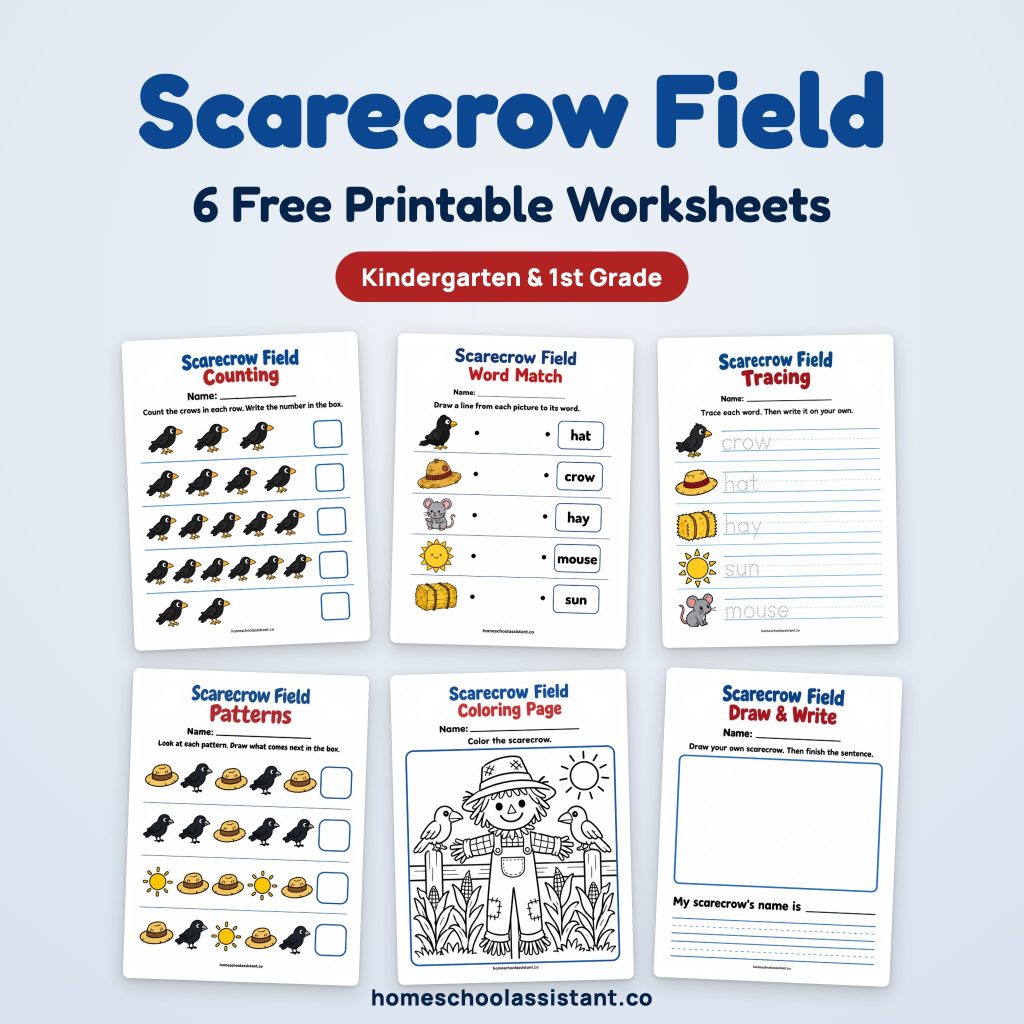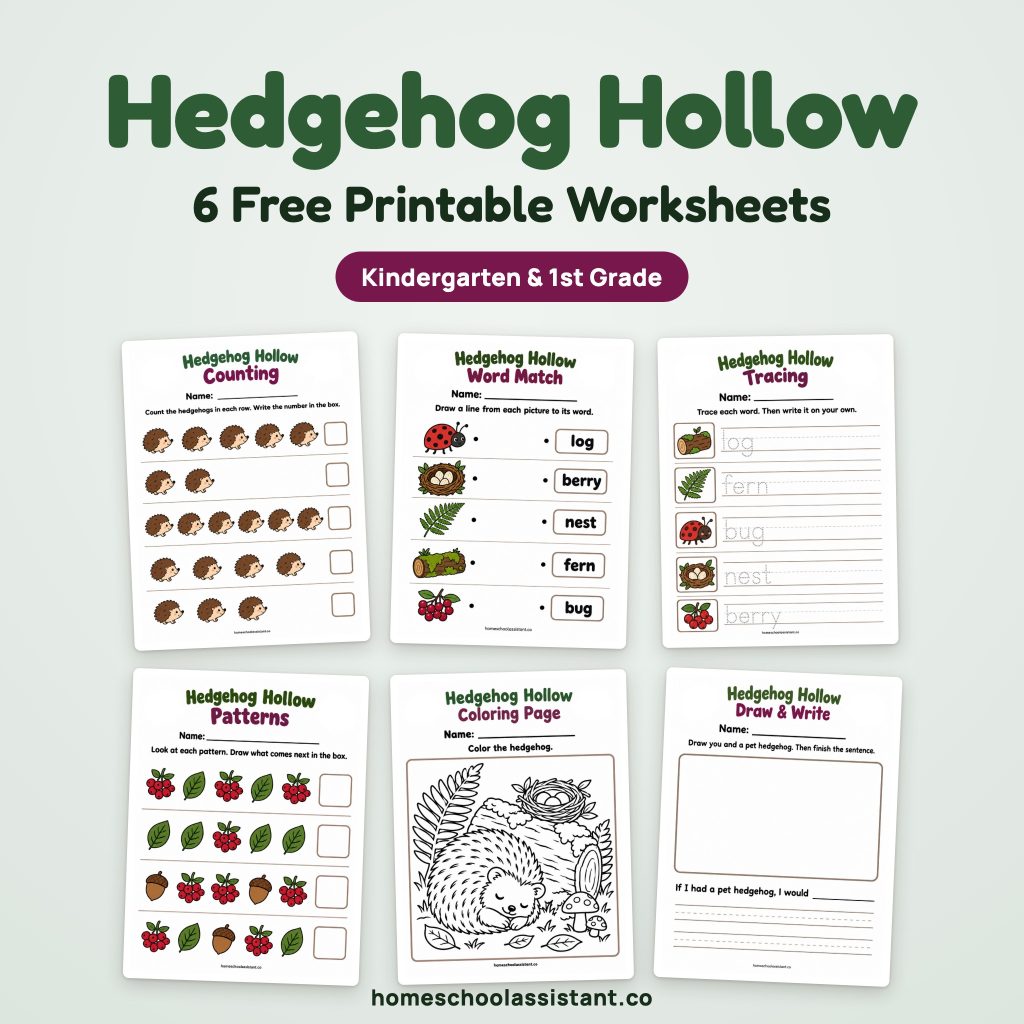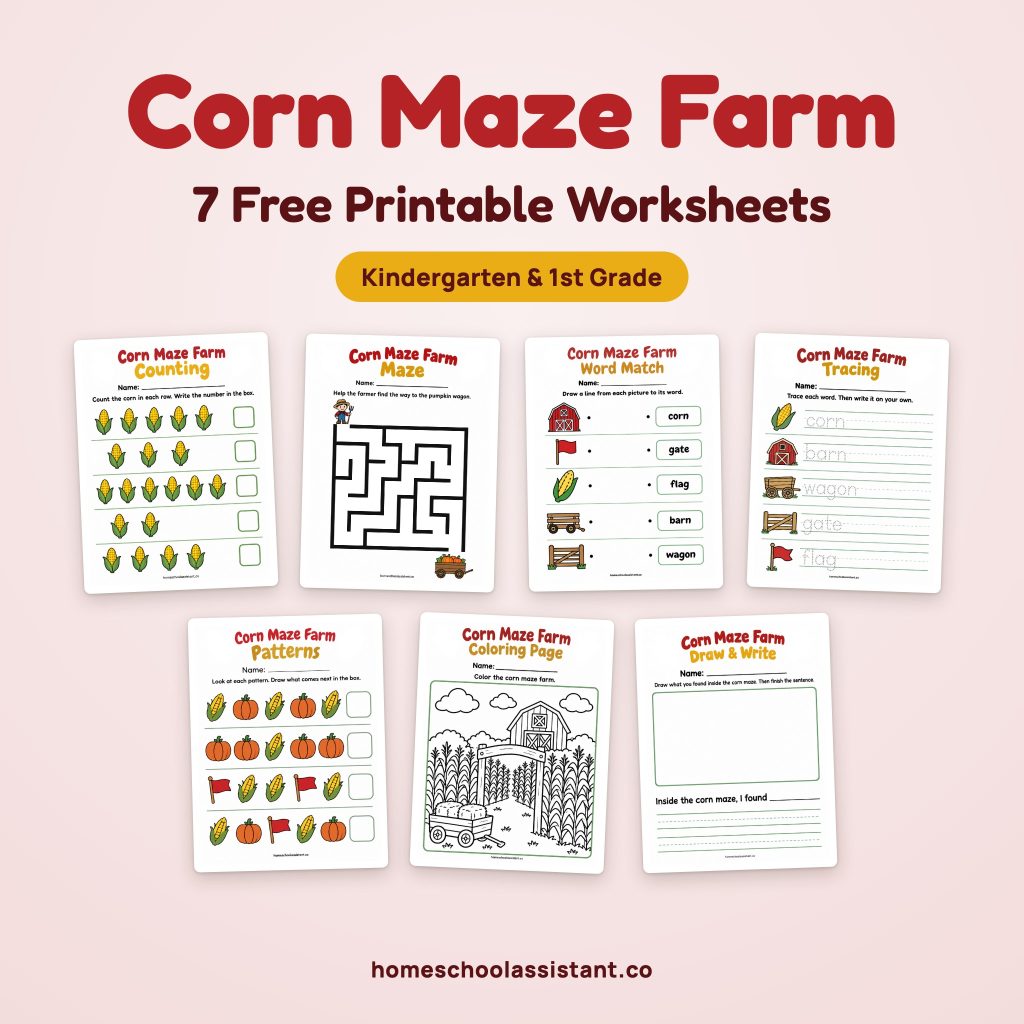
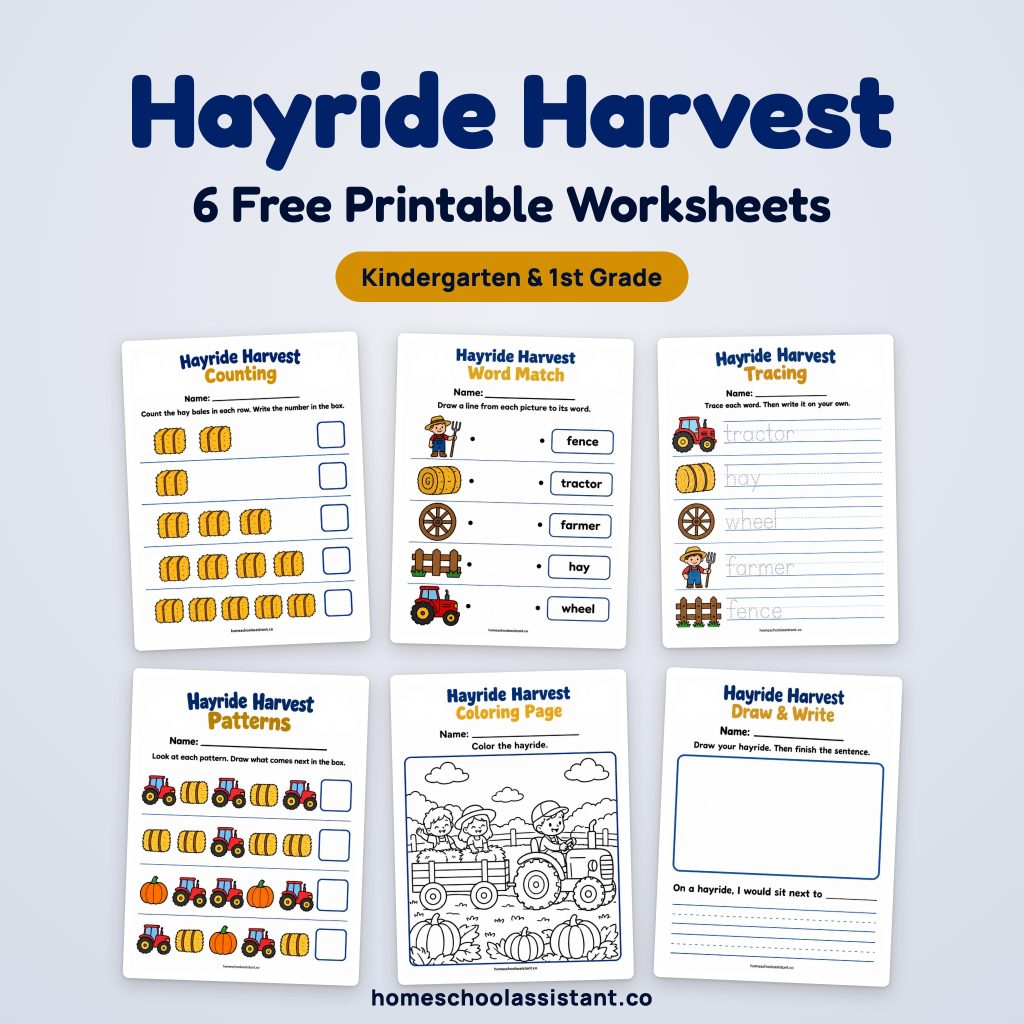
These free hayride harvest printables bring a farm field trip to your homeschool table. The six worksheets cover counting, phonics, handwriting, patterns, coloring, and writing, all built around a hay wagon ride: a tractor, hay bales, a wagon wheel, a farmer, and a fence.
The set is made for kindergarten and first grade, and preschoolers can join in on the counting and coloring pages. Each page takes about ten minutes to finish.
Free for your family, co-op, or classroom. Prints on regular letter paper. Every page is checked for mistakes before we post it.
What's in the hayride harvest printables
1. Counting hay bales
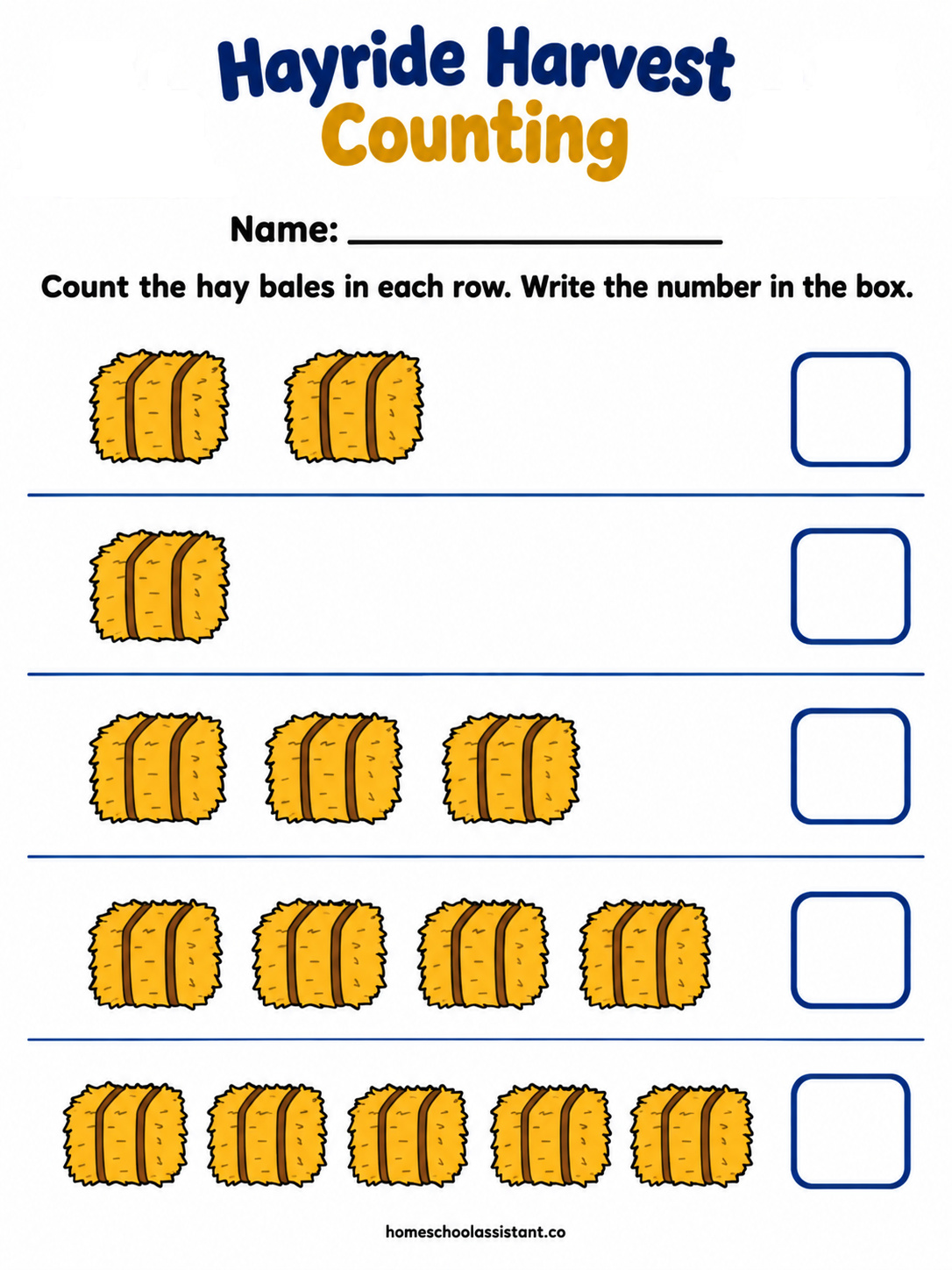
Five rows of hay bales, from one up to five, in mixed order. Kids count the hay bales in each row and write the total in the box.
Make it easier: Stack real blocks to match each row before writing the number.
Make it harder: Ask which row has the most hay bales, or how many rows two and three have together.
2. Word match
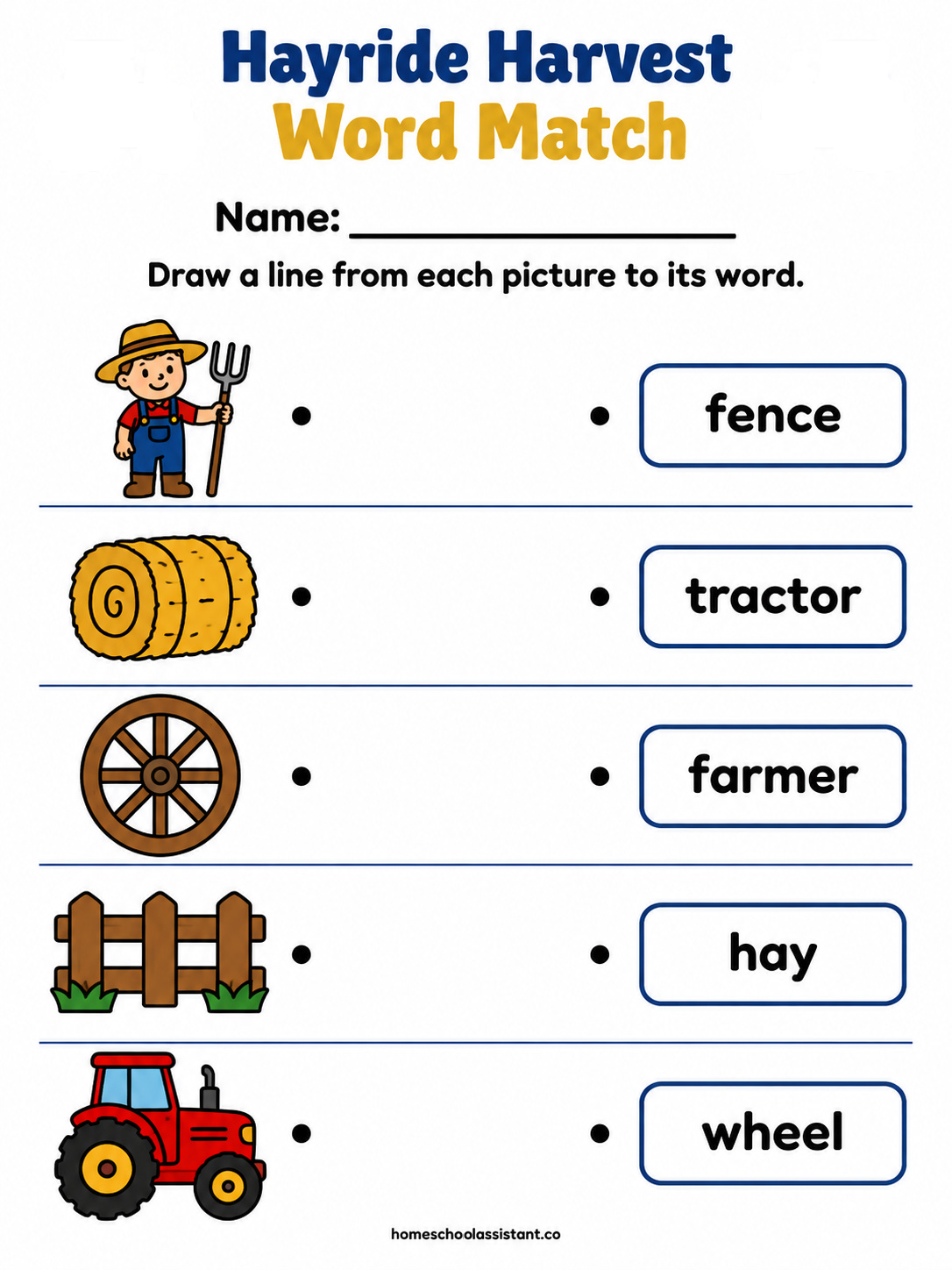
Draw a line from each picture to its word: a farmer, a hay bale, a wagon wheel, a fence, and a tractor. Early readers can sound out the f in farmer or the t in tractor, then check the rest.
Make it easier: Say tractor, hay, wheel, farmer, and fence aloud together before drawing any lines.
Make it harder: Hide the words and have your child spell each one from the picture.
3. Tracing
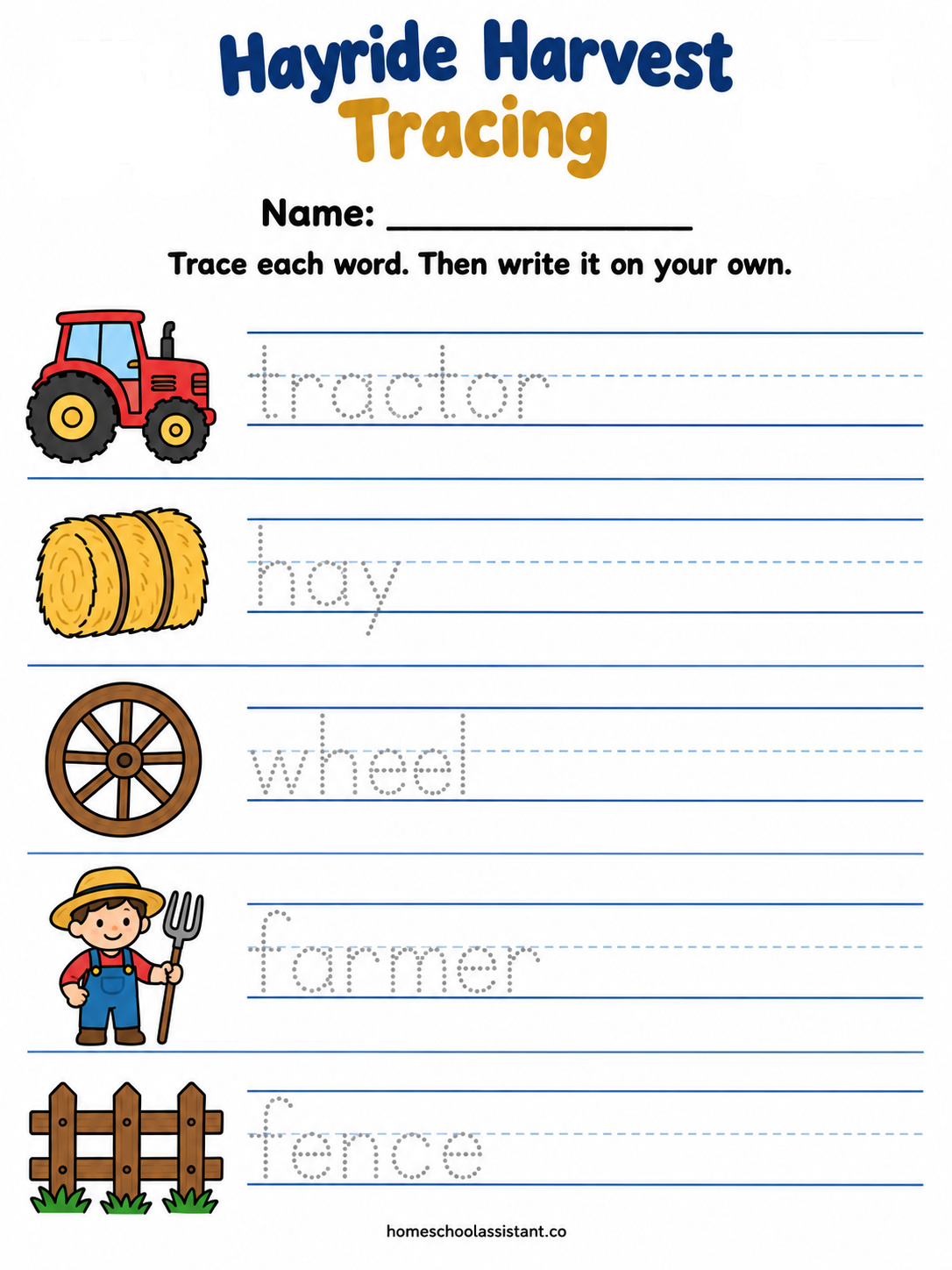
The same five words again. Kids trace the dotted word, then write tractor, hay, wheel, farmer, or fence on the line below.
Make it easier: Trace just the first letter of each word, or trace with a finger first.
Make it harder: Hide the tracing box and see if your child can write all five words from memory.
4. Patterns: what comes next?
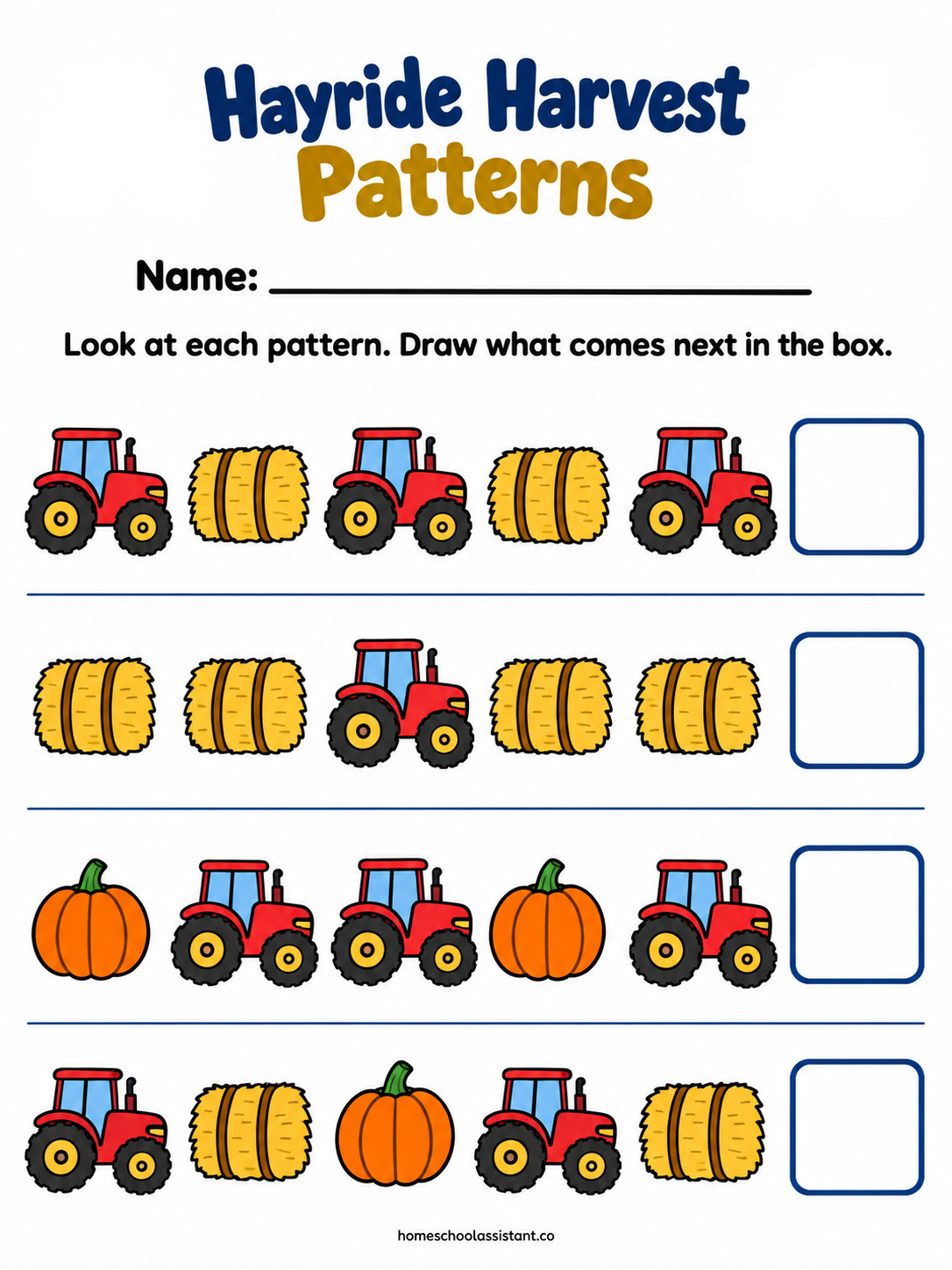
Four rows, each with its own rule: tractor/hay bale alternating, two hay bales and a tractor repeating, a pumpkin and two tractors repeating, then a tractor, a hay bale, and a pumpkin repeating. Kids draw what comes next in the box.
Make it easier: Build row one with two toys or blocks before your child draws it.
Make it harder: Ask your child to explain each rule, then invent a new pattern.
5. Coloring page
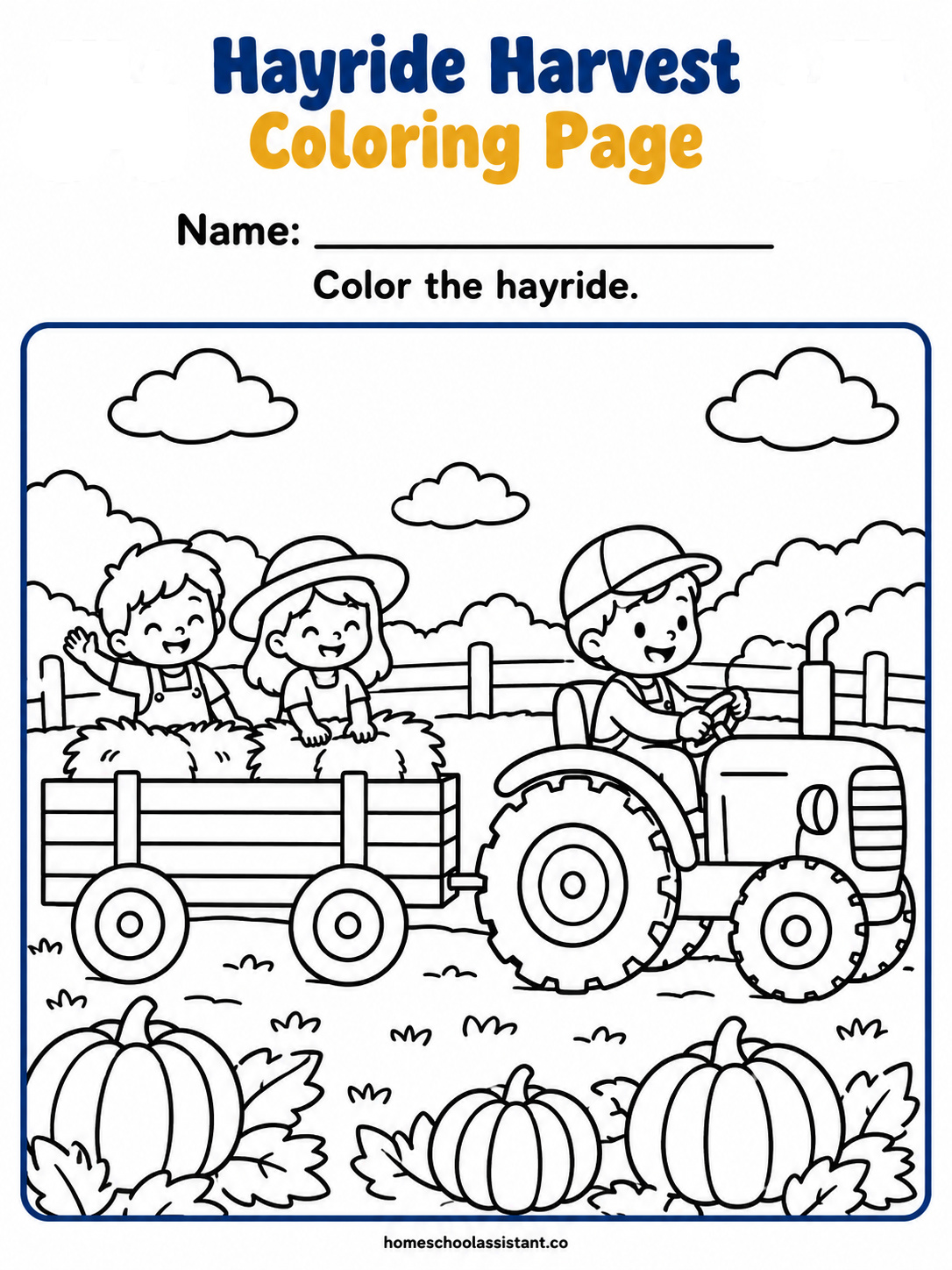
A tractor pulling two happy kids on a wagon full of hay, rolling past a pumpkin field. One of our most requested hayride coloring pages: bold, simple lines for small hands, with open space for crayons.
Make it harder: Color the hay bales one color and the pumpkins another to make the field easy to spot.
6. Draw and write
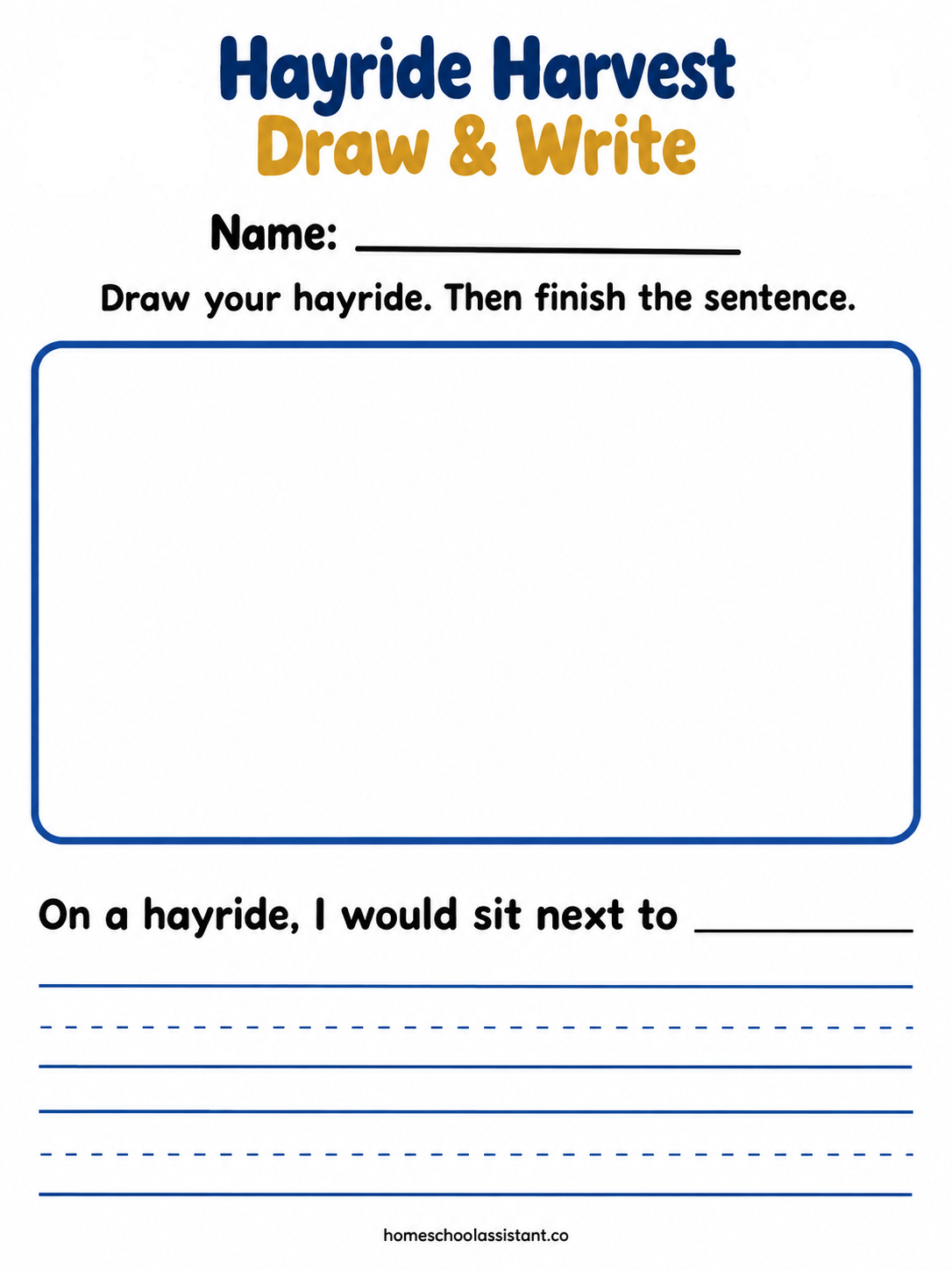
Kids draw their own hayride, then finish the sentence “On a hayride, I would sit next to…” on the lines below.
Make it easier: Your child tells you who they’d sit by, you write it lightly, and they trace over it.
Make it harder: Write two sentences about the hayride, checking for a capital letter and a period.
What kids practice with these hayride worksheets
- Counting and writing numbers. Kids count groups up to five and write the matching number.
- Phonics. Real patterns worth pointing out: the ay team in hay, the wh digraph and ee team in wheel, the r-controlled vowels in farmer (both “ar” and “er”), and the soft c in fence.
- Handwriting. Tracing the dotted word, then writing tractor, hay, wheel, farmer, or fence without help.
- Patterns. Four tractor-and-hay-bale rules, moving from a two-item repeat to a three-item repeat.
A simple 5-day hayride harvest plan
- Monday: Stack five soft blocks like hay bales, then do the counting page.
- Tuesday: Point to the tractor, hay bale, wheel, farmer, and fence, then do the word match page.
- Wednesday: Do the tracing page; point out the two “ar” sounds in farmer.
- Thursday: Line up toy tractors and blocks to build a pattern, then do the patterns page.
- Friday: Visit a farm or watch a video of a hay wagon, color the hayride, and finish the draw-and-write page.
Using the set in preschool, kindergarten, and first grade
Preschool: Focus on counting, coloring, and the first two pattern rows; skip the writing pages.
Kindergarten: Work straight through the set, nothing to change.
First grade: Try the harder option each page and ask for a full sentence on the last page.
Why farmers bale hay
Hay is grass or alfalfa cut while still green, then left to dry in the sun. Once dry, a machine pulled behind a tractor rolls or presses it into tight bales, easy to stack and store. Farmers keep those bales in a barn to feed horses, cows, and other animals through winter, when fresh grass stops growing. The hay wagon on the coloring page is usually the same flatbed trailer farmers use to haul bales, just filled with loose hay for a ride.
Hayride and farm books to read with this set
- Tractor Mac: Autumn Is Here by Billy Steers
- Click, Clack, Moo: Cows That Type by Doreen Cronin
- Big Red Barn by Margaret Wise Brown
Printing tips and answer key
- Print only the pages you need for the day; each one stands alone.
- Put the counting, tracing, and patterns pages in a plastic sleeve for dry-erase reuse.
- Print the coloring page on cardstock if your child prefers paint over crayons.
Answers: Counting, top to bottom: 2, 1, 3, 4, 5 (in mixed order). Patterns, top to bottom: row 1 (tractor, hay, tractor, hay, tractor) → hay bale; row 2 (hay, hay, tractor, hay, hay) → tractor; row 3 (pumpkin, tractor, tractor, pumpkin, tractor) → tractor; row 4 (tractor, hay, pumpkin, tractor, hay) → pumpkin.
Want every set in one place?
Sorted by season and topic, with one-click downloads.
Plan the rest of your homeschool week
Homeschool Assistant helps you plan lessons, track each child’s progress, and celebrate the wins, all in one place. You can start free.

Written by
Learn about Homeschool Assistant →